


INTERVIEW: Lebanese PM’s meeting with Sisi ‘extremely fruitful’
Saturday, Dec 11, 2021
Al-Ahram - Mohamed El-Qazzaz
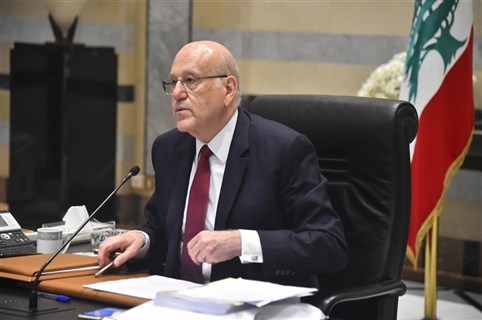
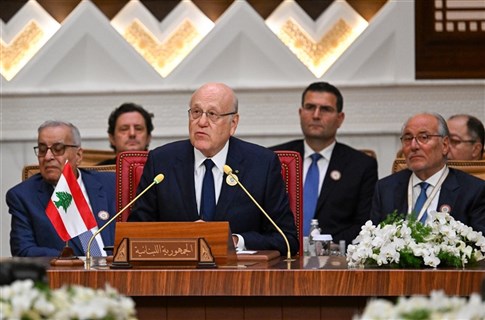
Talking about Egypt’s cooperation with Lebanon to solve the countries energy crisis and develop its economy, Ahram Daily Newspaper interviewed Lebanese Prime Minister Najib Mikati.
On Thursday 11December, Lebanese Prime Minister Najib Mikati paid his first visit to Cairo after assuming the position in September 2021, where he met with President Abdel-Fattah El-Sisi and his Egyptian counterpart Mostafa Madbouly.
Ahram Daily Newspaper interviewed the prime minister, asking about cooperation between the two countries, including energy projects and gas exports to Lebanon.
Ahram Daily: First of all, how would you describe your visit to Egypt and meeting with President Abdel-Fattah El-Sisi?
Najib Mikati: First, I am happy to visit Egypt and to meet His Excellency President Abdel-Fattah El-Sisi. Our meeting was extremely fruitful where I found someone who is sad about the current situation of Lebanon. President El-Sisi spoke about Lebanon and the Lebanese people, adding that political and economic reforms in Lebanon are important and must focus on the Lebanese citizen and his life. This gives us a great incentive to continue our work.
AD: How do you view the current efforts to boost economic cooperation between Egypt and Lebanon, especially after the agreement between the Lebanese government and Arab Contractors in August 2021 to develop the port of Tripoli?
NM: When we signed the contract with the Arab Contractors Company to develop the port of Tripoli, it was a happy hour for us; first, for my hometown Tripoli to expand and establish the infrastructure making this vital port fully functional, and second, to have an Egyptian company with the history of Arab Contractors doing the project is a great opportunity.
I knew since yesterday that work will start soon, and everything is happening as desired, considering the funding and implementation of all the demands that is are in the agreement.
AD: This is concerning the port, but what about importing gas from Egypt? Especially since there are still challenges facing this project. Is there a timetable for its implementation?
NM: The only challenge – as you know – for the Egyptian gas to reach Lebanon is that it must pass through Syria and in Syria, there is [US legislation] Caesar Act that imposes sanctions on whoever gives financial and technical support to the Syrian government. For the gas pipeline to pass through Syria, the Egyptian and Jordanian governments received written approval from the US administration after applying the Caesar Act to the project. It was a relief for Egypt and Jordan, and of course for Lebanon.
That’s why we agreed with the Egyptian government to provide Lebanon with 650 million cubic metres per year.
In our meeting with President El-Sisi, we asked to increase this quantity and he promised to study the matter. The Egyptian government will deliver gas to Lebanon after carrying out the necessary repairs on the gas pipeline from Syrian borders to electricity plants in Lebanon.
AD: But Prime Minister, there are reports saying that the Arab gas pipeline has not worked for 10 years, and the Syrian electricity grid is dilapidated. How are you going to deal with this challenge?
NM: Yes, and for this reason, we are asking for its rehabilitation and we agreed with an Egyptian company to carry out this rehabilitation.
AD: Prime Minister, your visit to Cairo comes while Lebanon is witnessing several diplomatic, economic and political crises. What is your impression of these crises?
NM: Since when has Lebanon not seen crises in the past decades? Lebanon is always besieged with crises.
Unfortunately, the current implementation of Taif agreement and the constitution resulted in crises rather than solving the crises. There are many articles and provisions that have not been implemented like the Constitutional council, the Senate and the cancellation of political sectarianism.
We are moving against the roadmap made by the Taif agreement unfortunately.
AD: You stated that the Lebanese government is working, but at the same time the cabinet’s meetings are suspended due to the boycott of the Shia duo, Hezbollah and the Amal movement; can you explain to us this contradiction? How are the governmental decrees discussed and taken?
NM: Today, we have a faction from Lebanese society that boycotts the meetings of the cabinet and so I, as Najib Mikati, call for reconciliation and cohesion…
Therefore, I work on the government as well as working with the ministers individually or with a group with of them in order to implement the plans we have without returning back to the cabinet, like for instance the gas pipeline agreement with Egypt and Jordan and the development of the Tripoli port.
This means the government is complete and does its role fully, but that does not mean we do not need the cabinet; we need the cabinet, but we have a bigger evil and a smaller evil. The smaller evil protects us from the bigger evil; the smaller evil is when the cabinet does not convene, while the bigger evil is further division between Lebanese people that can’t be fixed easily.
AD: But Prime Minister, many say that the cabinet won’t hold its meetings if Judge Tarek Bita, who leads the investigations of the 2020 Beirut Port explosion, is not dismissed from his position?
NM: The cabinet will hold its meeting in the right time, but concerning Judge Bitar, the government does not interfere in the work of judiciary and I am one of the people who signed the draft law to establish an independent judiciary authority and I can’t contradict myself by interfering in the investigation.
I never interfere in the judiciary ever and I have never spoken with a judge during my political career.
AD: But you have not answered me concerning the linkage between the return of cabinet meetings and the dismissal of Judge Bitar?
NM: There is a constitutional order that stipulates that presidents, ministers and member of parliament stand trial in front of the Supreme Council of the Trial of Ministers and Presidents, which is a court of the highest eight judges, and seven deputies.
As Judge Bitar pursues a former prime minister and ministers, those defendants or witnesses should not be referred to trial or stand a trial in front of the Supreme Council before the parliament says its word on this matter.
I want a separation of powers in Lebanon; there is a military court for the military in Lebanon, and judicial inspection of judges, ministers and presidents has a special body too.
I say it frankly there is a constitutional order higher than law that must be respected.
AD: What are the urgent priorities for the Lebanese government?
NM: There are many different priorities like, first, safeguarding internal security, border security and security with United Nations Interim Force in Lebanon (UNIFL), financial issues and talks and social issues.
There are three [more] extremely important priorities: first, the financial issue and the talks with the International Monetary Fund (IMF) as well as the plan to return deposits to depositors; second, to solve the electricity crisis; and third, to hold parliamentary elections on time.
AD: Lebanese people are concerned about their deposits and there is some despair that they won’t receive them. How do you answer that?
NM: The deposits of the Lebanese people will not be lost.
AD: Lebanon started its talks with the International Monetary Fund (IMF) regarding economic reforms. How will the angry Lebanese street tolerate those reforms and what is the role of the government in this?
NM: The demands of the IMF were nearly implemented without making demands on the Lebanese people in terms of lifting subsidies on goods; today... nothing is subsidized in Lebanon whether medicine or energy or food. The important measures have been carried out and the Lebanese citizen is fully aware that this is one of the conditions to reach an agreement with the IMF.
AD: In April 2020, there was a complete reform plan to end Lebanon’s financial, economic and social crises but the Lebanese banks objected to the plan. Is there another reform plan you are working on?
NM: Yes, there is a new reform plan, which took into consideration both the rights of the depositors and the interest of the banks in addition to the restructuring of the banks, which is an essential thing to us.
AD: After the visit of French President Emmanuel Macron to Saudi Arabia and the resignation of the Information Minister George Kordahi last week, are there any steps to restore the relations between Lebanon and Gulf state? When will the Saudi ambassador return to Lebanon?
NM: For Lebanon and the Lebanese, we have never thought of cutting relations with any Arab country. We are Arabs and we need our Arab brothers and the relations between Arab countries must be brotherly and the diplomatic relations will return at the right time.
AD: Prime Minister, after the resignation of Information Minister George Kordahi, are you thinking about appointing a new minister or is there is a push to abolish the Ministry of Information? Especially considering that reforms declared by the government in October 2019, following the mass protests, called for abolishing the ministry and replacing it with a national council for visual and audio media?
NM: Frankly, I can’t summarize the whole issue. I and his excellency President Michel Aoun accepted the resignation, but we have not resolved yet the matter of appointing a new minister. I have not not deeply discussed with President Aoun appointing a new minister for information, especially since the Ministry of Information does not have a big responsibility.
Currently, Minister of Education and Higher Education Abbas El-Halabi is appointed as acting information minister till we will see what we can do about this matter.
AD: The implementation of the 2006 UN Security Council Resolution No.1680 on the demarcation and control of the Lebanese-Syrian border is of great importance. What are the Lebanese government's steps in implementing the resolution?
NM: For our part, we are ready to demarcate the Lebanese-Syrian border, but can we define these borders on our own? We must start discussing this issue with our Syrian brothers in a fraternal and friendly way, not in a way imposed on us from the outside. When we and the Syrians sit at one table, we will inevitably reach a solution.
AD: From time to time, there are demands to reconsider the Taif Agreement and agree on a new national charter. How do you look to those demands?
NM: Frankly, the Taif Agreement and the constitution are still the best to govern Lebanon, but there is mismanagement and mis-implementation in addition to the failure to complete the agreement.
Before calling to amend Taif Agreement, we should agree to fully implement it and its points. Maybe this will lead us to a Lebanon that is founded on the basis of modern elections that leads to a non-sectarian House of Representatives and a Senate that protects the rights granted in the Taif agreement.
All those matters and issues are mentioned in the Lebanese constitution and Taif agreement. It should be implemented correctly.
AD: Some argue that there are parties that want to prevent or postpone the parliamentary elections by fabricating security threats or exploiting the economic crisis. [What do you think about this claim?]
NM: No one can disrupt the parliamentary elections next year. No one can ask for the postponement of the elections. Although I know that some people do not want to hold elections, I will not entertain debate on this subject. No one can say that I am disrupting the elections.


